
logo
logo
Epidermal Growth Factor Receptor, phosphorylated (Tyr1173) (erbB, EGFR, EC=2.7.10.1, ERBB, ERBB1, MENA)

Cat no: E3375-15F

Epidermal Growth Factor Receptor, phosphorylated (Tyr1173) (erbB, EGFR, EC=2.7.10.1, ERBB, ERBB1, MENA)

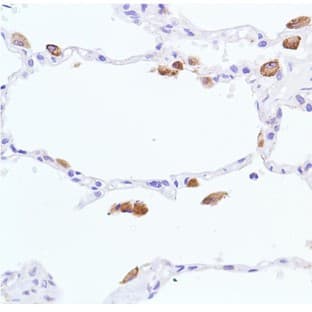
The epidermal growth factor receptor (EGFR; ErbB-1; HER1 in humans) is the cell-surface receptor for members of the epidermal growth factor family (EGF-family) of extracellular protein ligands. The epidermal growth factor receptor is a member of the ErbB family of receptors, a subfamily of four closely related receptor tyrosine kinases: EGFR (ErbB-1), HER2/c-neu (ErbB-2), Her 3 (ErbB-3) and Her 4 (ErbB-4). Mutations affecting EGFR expression or activity could result in cancer.\n\nEGFR (epidermal growth factor receptor) exists on the cell surface and is activated by binding of its specific ligands, including epidermal growth factor and transforming growth factor a (TGFa). Upon activation by its growth factor ligands, EGFR undergoes a transition from an inactive monomeric form to an active homodimer. In addition to forming homodimers after ligand binding, EGFR may pair with another member of the ErbB receptor family, such as ErbB2/Her2/neu, to create an activated heterodimer. There is also evidence to suggest that clusters of activated EGFRs form, although it remains unclear whether this clustering is important for activation itself or occurs subsequent to activation of individual dimers.\n\nEGFR dimerization stimulates its intrinsic intracellular protein-tyrosine kinase activity. As a result, autophosphorylation of five tyrosine (Y) residues in the C-terminal domain of EGFR occurs. These are Y992, Y1045, Y1068, Y1148 and Y1173. This autophosphorylation elicits downstream activation and signaling by several other proteins that associate with the phosphorylated tyrosines through their own phosphotyrosine-binding SH2 domains. These downstream signaling proteins initiate several signal transduction cascades, principally the MAPK, Akt and JNK pathways, leading to DNA synthesis and cell proliferation. Such proteins modulate phenotypes such as cell migration, adhesion, and proliferation. The kinase domain of EGFR can also cross-phosphorylate tyrosine residues of other receptors it is aggregated with, and can itself be activated in that manner.\n\nApplications: \nSuitable for use in Immunofluorescence, ELISA, Western Blot, Immunoprecipitation and Immunohistochemistry. Other applications not tested.\n\nRecommended Dilution:\nImmunofluorescence: 1:25-1:50\nWestern Blot: 1:1000\nImmunohistochemistry: 1:25-1:50\nImmunoprecipitation: 1:10\nOptimal dilutions to be determined by the researcher.\n\n\nQuality Control Testing\nImmunoblot Analysis: A 1:1,000 dilution of the lot detected endogenous phosphorylated EGFR (Tyr1173) in lysates from EGF stimulated A431 cells. Immunoprecipitation: A 1:10 dilution of this antibody immunoprecipitated phosphorylated EGFR (Tyr1173) using protein G:agarose beads. Immunohistochemistry: A 1:25-1:50 dilution of this antibody worked in immunohistochemical analysis of Paraffin-embedded human skin carcinoma using the anti-phospho-EGFR (Tyr1173). Immunfluorescence Staining: 1:25-1:50 of this antibody was used for Immunfluorescence staining of paraformaldehyde fixed cells. Immunoblot Analysis: Lysates from untreated and EGF treated A431 cells (lanes 1 and 2, respectively) were resolved by electrophoresis, transferred to PVDF and probed with antiphospho- EGFR (Tyr1173) (1:1,000). Proteins were visualized using goat anti-rabbit secondary antibody conjugated to HRP and chemiluminescence detection. Arrow indicates EGFR phosphorylated on Tyrosine 1173 (170kD).\n\nStorage and Stability:\nMay be stored at 4 degrees C for short-term only. For long-term storage, store at -20 degrees C. Aliquots are stable for at least 12 months at -20 degrees C. For maximum recovery of product, centrifuge the original vial after thawing and prior to removing the cap. Further dilutions can be made in assay buffer.

Prices direct from United States Biological

Quick response times

Exclusive Biosave savings/discounts

SPECIFICATIONS

Catalog Number

E3375-15F

Size

100ul

Applications

IF, IHC, IP, WB

Hosts

Rabbit

Reactivities

Hum

Form

Supplied as a liquid in 50mM Tris-Glycine, pH 7.4, 0.15M NaCl, 0.01% sodium azide, 0.05% BSA, 40% glycerol.

P Type

Mab

Isotype

IgG

References

1. Sturla, Lisa-Marie, et al (2005). J Biol Chem 280:14597-604. 2. Moro, Laura, et al (2002). J Biol Chem 277:9405-14.

Additional Info

Recognizes human EGFR phosphorylated on tyrosine residue 1173.

Alternative Names

EC=2.7.10.1, ERBB, ERBB1, MENA

Read more on Supplier website

Applications

FC

Hosts

Mouse

Reactivities

Hum

More info

Applications

FC

Hosts

Mouse

Reactivities

Hum

More info

Applications

FC

Hosts

Mouse

Reactivities

Hum

More info

Applications

FC

Hosts

Mouse

Reactivities

Hum

More info

Applications

FC

Hosts

Mouse

Reactivities

Hum

More info

Applications

FC

Hosts

Mouse

Reactivities

Hum

More info

Applications

FC

Hosts

Mouse

Reactivities

Hum

More info

Applications

FC

Hosts

Mouse

Reactivities

Hum

More info
Advertisehere
BMA Biomedicals Horizontal banner
BMA Biomedicals

Latest promotion FROM:

BMA Biomedicals
View promotion

Latest promotions

Spend less time on DNA cleanup so you can do more science. The MSB Spin PCRapace is the fastest way to purify your DNA from PCR, restriction digestion, and...
New brilliant antibodies, and new lower prices!For flow cytometry reagents in general, \"bright is better.\" The violet-excitable BD Horizon™ BV421 and...

As an incentive to qualify our BSA, we are offering a 20% discount when you purchase your first 100g, 500g or 1000g of any grade of Bovine Serum Albumin....
It is not every day that you are given something for nothing. We are giving away additional spectrophotometer software.Cecil Instruments have enhanced the...

We're so sure that you'll prefer Cayman Assay kits over your present brand that we're willing to give you a free assay kit to prove it!

Did your supplier increase the price of Fetal Bovine Serum? Did they substitute the US Origin with USDA? Well say no more! Innovative Research is still...

For the past decade scientists have extensively used ATS secondary toxin conjugates to make their own targeted toxins for in vitro use.The ability to combine...

10% Discount on 2 Rabbit Polyclonal Antibody Service. With over 20 years experience, SDIX has developed into the premier US custom antibody producer,...
Bulk Cytokines with Custom Vialing.20 - 50% off cytokines, growth factors, chemokines and more...For a limited time Cell Sciences is offering substantial...

Jenway’s 73 series spectrophotometer range provides four models with a narrow spectral bandwidth of 5nm and an absorbance range of –0.3 to 2.5A,...

Are you planning to have a customised antibody made for your research?Since 2000, Everest has been producing a catalog containing thousands of affinity...