
logo
logo
Clara Cell Protein (CC16, CC10, Uteroglobin, Urinary Protein 1, Clara Cell Secretory Protein, Secretoglobin Family 1A Member 1, CCPBP, Clara Cells 10kD Secretory Protein, CC10, UP1, Clara Cell Phospholipid-binding Protein, SCGB1A1, CCSP, UGB) (Azide Free)

Cat no: C5828-01D

Clara Cell Protein (CC16, CC10, Uteroglobin, Urinary Protein 1, Clara Cell Secretory Protein, Secretoglobin Family 1A Member 1, CCPBP, Clara Cells 10kD Secretory Protein, CC10, UP1, Clara Cell Phospholipid-binding Protein, SCGB1A1, CCSP, UGB) (Azide Free)

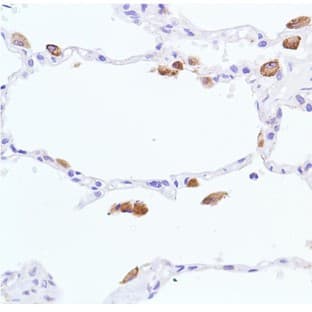
Clara cells are dome-shaped cells with short microvilli found in the small airways (bronchioles) of the lungs.[1] Clara cells are found in the ciliated simple epithelium. These cells may secrete glycosaminoglycans to protect the bronchiole lining. Bronchiolar cells gradually increase in number as the number of goblet cells decrease. They are also known as "bronchiolar exocrine cells".[2] "Clara cells" were originally described by their namesake, Max Clara in 1937. Clara was born in South Tyrol in 1899 and died in 1966. He was a Nazi doctor who used tissue from executed victims of the Third Reich for his research at Leipzig, including the work that led to his discovery of Clara cells.[3] Some scholars believe that the eponymous name of these cells should be changed because of the ethical controversy surrounding the discovery of the cells but other scholars disagree and think that the name should remain because it is a testament to a time when medicine crossed an ethical line.[4]\n\nOne of the main functions of Clara cells is to protect the bronchiolar epithelium. They do this by secreting a small variety of products, including Clara cell secretory protein (CCSP) and a solution similar to the component of the lung surfactant. They are also responsible for detoxifying harmful substances inhaled into the lungs. Clara cells accomplish this with cytochrome P450 enzymes found in their smooth endoplasmic reticulum. Clara cells also act as a stem cell and multiply and differentiate into ciliated cells to regenerate the bronchiolar epithelium.[5]\n[edit]Mechanism\n\nThe respiratory bronchioles represent the transition from the conducting portion to the respiratory portion of the respiratory system. The narrow channels are usually less than 2 mm in diameter and they are lined by a simple cuboidal epithelium, consisting of ciliated cells and non-ciliated Clara cells, which are unique to bronchioles. In addition to being structurally diverse, Clara cells are also functionally variable. One major function they carry out is the synthesis and secretion of the material lining the bronchiolar lumen. This material includes glycosaminoglycans, proteins such as lysozymes, and conjugation of the secretory portion of IgA antibodies. These play an important defensive role, and they also contribute to the degradation of the mucus produced by the upper airways. The heterogeneous nature of the dense granules within the Clara cell's cytoplasm suggests that they may not all have a secretory function. Some of them may contain lysosomal enzymes, which carry out a digestive role, either in defense: Clara cells engulf airborne toxins and break them down via their cytochrome P-450 enzymes (particularly CYP4B1, which is only present in the clara cells) present in their smooth endoplasmic reticulum; or in the recycling of secretory products. Clara cells are mitotically active cells. They divide and differentiate to form both ciliated and non-ciliated epithelial cells.\n\nClara cells contain Tryptase clara, which is believed to be responsible for cleaving the hemagglutinin surface protein of influenza A virus, thereby activating it and causing the symptoms of flu.[6] When the l7Rn6 protein is disrupted in mice, these mice display severe emphysema at birth as a result of disorganization of the Golgi apparatus and formation of aberrant vesicular structures within clara cells.[7]\n\nApplications:\nSuitable for use in ELISA and Immunohistochemistry (paraffin). Other applications not tested.\n\nRecommended Dilution:\nELISA: 1ug/ml-3ng/ml\nImmunohistochemistry (paraffin): 1.5ug/ml\nOptimal dilutions to be determined by the researcher.\n\nStorage and Stability:\nMay be stored at 4 degrees C for short-term only. Aliquot to avoid repeated freezing and thawing. Store at -20 degrees C. Aliquots are stable for at least 12 months. For maximum recovery of product, centrifuge the original vial after thawing and prior to removing the cap.

Prices direct from United States Biological

Quick response times

Exclusive Biosave savings/discounts

SPECIFICATIONS

Catalog Number

C5828-01D

Size

100ul

Applications

IHC

Hosts

Mouse

Reactivities

Hum

Form

Supplied as a liquid in PBS, pH 7.2. No preservative added (Azide free).

P Type

Mab

Purity

Purified by immunoaffinity chromatography.

Isotype

IgG2b

References

1. Atkinson JJ, Adair-Kirk TL, Kelley DG, Demello D, Senior RM (2008). \"Clara cell adhesion and migration to extracellular matrix\". Respir. Res. 9 (1): 1. doi:10.1186/1465-9921-9-1. PMC 2249579. PMID 18179694.\n2. Peter J. Papadakos; Burkhard Lachmann (29 August 2007). Mechanical Ventilation: Clinical Applications and Pathophysiology. Elsevier Health Sciences. pp. 74

Additional Info

Recognizes human SCGB1A1.

Read more on Supplier website

Applications

ELISA

Reactivities

Hum

More info

Applications

IF

Hosts

Mouse

More info

Applications

ELISA, WB

Hosts

Mouse

Reactivities

Hum

More info

Applications

ELISA, FC, WB

Hosts

Mouse

Reactivities

Hum

More info

Applications

ELISA, FC, IHC, WB

Hosts

Mouse

More info

Applications

IHC, WB

Hosts

Rabbit

Reactivities

Hum

More info

Applications

ELISA, WB

Hosts

Rabbit

Reactivities

Hum

More info
Advertisehere
MtoZ Horizontal banner
MtoZ Biolabs

Latest promotion FROM:

MtoZ Biolabs
View promotion

Latest promotions

Spend less time on DNA cleanup so you can do more science. The MSB Spin PCRapace is the fastest way to purify your DNA from PCR, restriction digestion, and...
New brilliant antibodies, and new lower prices!For flow cytometry reagents in general, \"bright is better.\" The violet-excitable BD Horizon™ BV421 and...
As an incentive to qualify our BSA, we are offering a 20% discount when you purchase your first 100g, 500g or 1000g of any grade of Bovine Serum Albumin....
It is not every day that you are given something for nothing. We are giving away additional spectrophotometer software.Cecil Instruments have enhanced the...

We're so sure that you'll prefer Cayman Assay kits over your present brand that we're willing to give you a free assay kit to prove it!

For the past decade scientists have extensively used ATS secondary toxin conjugates to make their own targeted toxins for in vitro use.The ability to combine...

10% Discount on 2 Rabbit Polyclonal Antibody Service. With over 20 years experience, SDIX has developed into the premier US custom antibody producer,...
Did your supplier increase the price of Fetal Bovine Serum? Did they substitute the US Origin with USDA? Well say no more! Innovative Research is still...
Bulk Cytokines with Custom Vialing.20 - 50% off cytokines, growth factors, chemokines and more...For a limited time Cell Sciences is offering substantial...
Jenway’s 73 series spectrophotometer range provides four models with a narrow spectral bandwidth of 5nm and an absorbance range of –0.3 to 2.5A,...

Are you planning to have a customised antibody made for your research?Since 2000, Everest has been producing a catalog containing thousands of affinity...